Open plan in office design
Pros and cons of open-plan offices
Open-plan office design remains one of the most powerful tools available to organisations seeking to refresh their workplaces and support modern patterns of work. It promises a more connected, agile environment, yet it also raises questions about noise, privacy and whether people can genuinely focus. We examine how to maximise the benefits of open-plan design by mitigating its drawbacks through zoning, acoustics, privacy solutions, and strategic furniture selection.
Why open plan still matters
For many leadership teams, open-plan design is attractive because it can make more efficient use of space while supporting new ways of working, such as agile project teams and hybrid attendance patterns. When partitions are minimised, a floorplate can accommodate a higher headcount without feeling cramped, reducing the cost per workstation and delaying the need for relocation. At the same time, colleagues can see one another, pick up on visual cues, and quickly resolve simple questions, rather than relying on email or formal meetings.
An open environment also allows natural light to penetrate more deeply into the space. This is not just a matter of aesthetics. Daylight exposure is linked to well-being and alertness, which has a measurable impact on performance and satisfaction. With fewer solid walls, mechanical ventilation and cooling systems can often be simplified, lowering both capital and operating costs. However, specialist advice from building services engineers is usually required to model the impact on airflow and thermal comfort.
Open-plan layouts remain popular due to their adaptability: desks can be rearranged for project teams, technology can be easily relocated, and furniture can be adjusted to staffing levels. For organisations that are growing or restructuring, this capacity to respond quickly can be as valuable as the initial space saving. Yet an open plan office must do more than house people efficiently. It needs to provide them with a genuine choice of workplaces.
The real drawbacks of open plan
Criticism of open-plan working is widely discussed and should not be ignored during a refurbishment. Noise from conversations, phone calls, and equipment can make it difficult for individuals to concentrate for more than a few minutes. Even when colleagues speak quietly, overlapping voices create a background level of distraction that forces the brain to work harder, leading to fatigue and reduced accuracy. Employees who handle sensitive information may also feel uncomfortable making calls or discussing confidential matters in the presence of others.
Visual distractions are another concern. In a fully open setting, people are continually aware of movement around them as colleagues walk past or gather nearby. While this level of activity can convey energy and dynamism, it may also cause some individuals to feel constantly observed. When there is no clear way to step out of the main work area, staff may work from home more frequently simply to gain some thinking time, which can undermine the intended benefits of the new office.
A further drawback is the assumption that a single environment can accommodate every task. Finance and legal teams often require long stretches of concentrated work. Product development and marketing colleagues need moments of noisy, energetic collaboration. Customer service teams field calls that cannot simply be moved elsewhere. If all these needs are squeezed into a single, undifferentiated open-plan space, every group is likely to feel compromised. The solution is not to return to a maze of individual rooms, but to plan distinct zones with clearly defined purposes.
Zoning for productive variety
Effective open plan offices now rely on a zoning strategy that organises space by activity. Instead of requiring everyone to perform every task at the same desk, the business offers a range of settings employees can choose from throughout the day. A quiet focus zone might offer generously spaced workstations with high screens, soft surfaces and rules that ask people to take calls elsewhere. A collaboration zone could be located near circulation routes and include project tables, writable surfaces, and presentation technology.
Between these two extremes, there may be team neighbourhoods that combine standard workstations with a few informal meeting points. These neighbourhoods give each team a sense of territory without cutting them off from the rest of the business. Location is important. Focus areas should be placed away from main routes and noisy facilities such as kitchens or print hubs. Collaborative zones can be placed near entrances and social spaces so that animated conversations feel natural rather than disruptive.
Zoning also supports hybrid and flexible attendance patterns. By providing touchdown spaces with shared screens and reliable power and data, organisations can accommodate visiting staff and partners without assigning permanent desks that sit empty for much of the week. Where zones are clearly signposted, both physically and through workplace guidelines, employees quickly learn where to go for particular tasks. This reduces friction, minimises conflict over noise, and helps people feel genuine control over their environment.
Acoustics and privacy in practice
Acoustic design is often the difference between an open-plan office that people endure and one they actively enjoy using. The starting point is to consider three components: absorption, blocking and masking. Absorption is achieved through materials that absorb sound energy, such as acoustic ceiling tiles, wall panels, carpet, and upholstered furniture. When these elements are specified appropriately and distributed evenly, they reduce reverberation so that sounds decay more quickly and conversations do not carry as far.
Blocking focuses on preventing sound from travelling directly between sources and receivers. In practice, this may involve higher desk screens, acoustic partitions around meeting areas and the strategic use of storage units or plant displays to interrupt the line of sight. In enclosed rooms, the acoustic performance of walls, doors, and glazing is crucial. Designers often work with manufacturers to select products with suitable sound-reduction ratings so that confidential discussions do not leak into the open space.
The third component, masking, involves introducing a controlled background sound, often through a dedicated system that distributes a gentle, consistent noise across the floor. Masking reduces the intelligibility and distractibility of intermittent speech. While not a replacement for absorption and blocking, it's a useful refinement, especially in spaces with fluctuating occupancy. Alongside these technical measures, the inclusion of small focus rooms, phone booths and enclosed meeting spaces allows staff to step away from the open area when privacy is essential.
Furniture as a flexible tool
Furniture selection and layout provide the final layer in a practical open-plan design and have particular appeal for businesses that want adaptability without ongoing construction. Sit-stand workstations give individuals control over posture and reduce the health risks associated with prolonged sitting. Task chairs with proper lumbar support, adjustable arms and responsive mechanisms help staff to work comfortably for longer, which is essential if organisations wish to encourage regular office attendance.
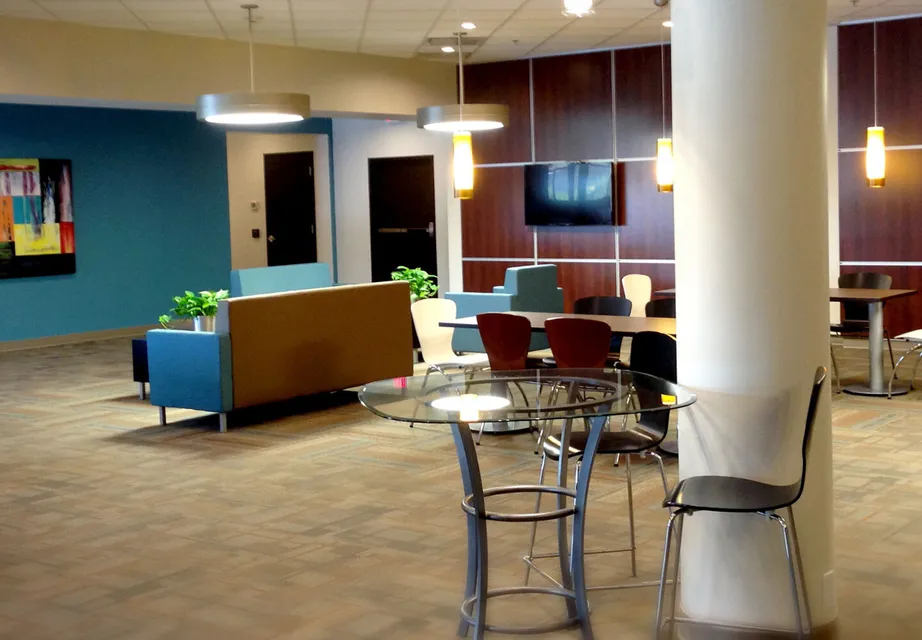
Modular soft seating is now widely used to create semi-enclosed nooks that act as alternative work settings and informal meeting spaces. High-backed sofas, booths with tables, and curved benches offer shelter without full walls. With acoustic linings and power outlets, they are ideal for quick meetings or video calls. Adding planters or storage units enhances visual and acoustic separation.
Mobile elements add another level of agility. Lightweight tables, stacking chairs, writable screens and portable storage enable teams to reshape their environment in response to changing priorities. Over time, organisations can adapt their layout simply by reconfiguring furniture, rather than commissioning new partitions. This protects the original investment in the fit-out and extends the space's life. When furniture is chosen with durability, sustainability credentials and repair options in mind, it also supports environmental targets and corporate values.
Thoughtful open-plan office design, therefore, rests on some simple yet powerful ideas. Treat the floorplate as a landscape of zones rather than a single room. Address acoustics and privacy through materials, layout and behaviour. Use furniture not just as equipment, but as an active tool for shaping experience. When these principles are followed, open-plan offices can deliver the collaboration, efficiency, and brand presence that businesses seek without sacrificing the focus and comfort employees need.